
Amid general chipmaker bloodbath, SK Hynix and Samsung, which make up half of the index, crashed even more.
By Wolf Richter for WOLF STREET.
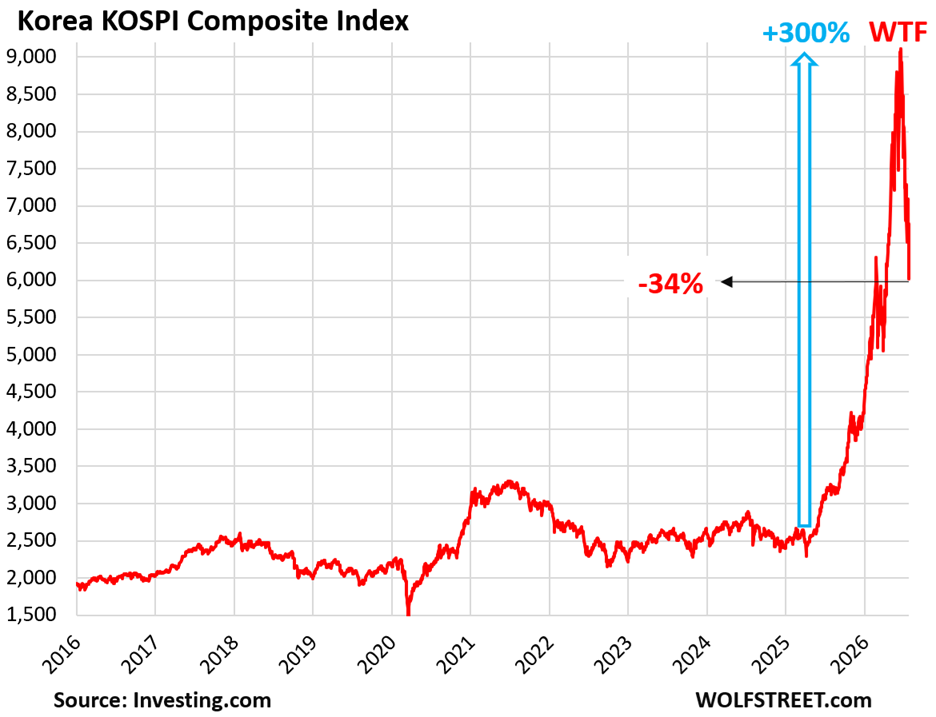
The South Korean KOSPI Composite Index crashed 10.8% today (July 28), as shares of Korea’s two big chipmakers, SK Hynix and Samsung, which make up about half of the KOSPI, plunged even more amid the general chipmaker bloodbath.
Since the peak on June 22, 2026, in just 25 trading days, the KOSPI has now plunged by 34%, interrupted only by violent sucker rallies.
In the morning local time, as the KOSPI plunged through the -5% line amid margin calls, forced selling, short-selling, and desperation, Korea Exchange activated a sell-side sidecar, which halted program selling for five minutes. But that didn’t accomplish much.
When the market crashed through the -8% line, Korea Exchange activated a first-stage circuit breaker, which halted all trading across the entire stock market for 20 minutes. But that didn’t accomplish much either, and shares continued to plunge.
But the KOSPI had spiked by 300% from April 2025 to June 2026, in a phenomenal display of consensual hallucination, having replaced cryptos as favorite get-rich-quick gambling tokens, or whatever.
And the 34% plunge in 25 days only took the index back to where it had been on April 15 this year. So only about 9 weeks of gains evaporated.
To unwind an entire year of gains, the KOSPI would have to drop a total of 71% from the peak in June. The Nasdaq during the US Dotcom Bust crashed by 78% over a period of 2.5 years. So it’s doable.
The two big Korean chipmakers, which together account for about half of the KOSPI, and which have become crypto-like gambling tokens, plunged in near-lockstep in Korean trading:
- SK Hynix: -14.4% today and -48% from the peak in June.
- Samsung Electronics: -13.6% today; -41% from peak in June.
Now everyone is waiting for the dip-buyers to jump in and trigger another sucker rally.
The plight of the KOSPI dragged down another red-hot market, the Nikkei 225 Index, which plunged nearly 4% today.
In the US, the semiconductor rout lags the rout in South Korea, but it has still been painful. The PHLX Semiconductor Index [SOX] has dropped by 21% from its peak on June 21, after a gigantic spike.
Enjoy reading WOLF STREET and want to support it? You can donate. I appreciate it immensely. Click on the mug to find out how:


Wow! another gleeful blog when the market tanks but never a gleeful article as the markets and stocks start their runs up and through 100s of % gains. Another no value article from Wolfy.
How much did you lose? Look at the bright side, now it’s your chance to buy!
GringoGreg,
So this is 24 hours after I posted this article. And now the KOSPI is down another 12%. But I’m not staying up again to write an article about it. I’m going to bed and let the KOSPI go where it wants. Charts like the one in the article invite that kind reversal. They nearly always get it. It’s not “gleeful” but logic.
Agreed how dare Wolfy educated us. I demand my blanket and Ostrich hole.
The gleeful articles on the way up are everywhere, there is no shortage of them. I’ll bet the rest of the business MSM doesn’t mention KOSPI.
I appreciate Wolf for being a “lone wolf.”
GringoGreg,
Did you already forget my article when MU spiked to over $1 trillion in market cap? You actually commented on my gleeful article about the spike. At the very top of the comments, I replied to the first comment, “Yes, this time it’s different! 💔” I replied to the first commenter. Follow that thread down, and you’ll see your comment. You just forgot.
https://wolfstreet.com/2026/05/27/micron-the-wtf-ai-mania-chart-of-the-year/#comment-681769
I cannot wait for AI to replace human brains, at least AI doesn’t forget 🤣
This is the chart I celebrated in that that article that you commented on and now forgot:
Since that Micron article in May, MU round-tripped up to 1250 in June, and then back down to about 820 right now.
Bonus thought: On the daily chart, MU is clinging to the neckline of a juicy head-and-shoulders pattern. A break below 800 would bring out a lot of short sellers for a trip down to 600 or so…
Micron now off another -9%, down to 744…
.. already more than halfway from the all-time-high (1254) to the Imploded Stocks list (target price: 376)…
What’s wrong with recognizing (and even celebrating) a drunk’s occasional efforts toward sobriety?
I guess we’ll see, won’t we? The drop is already becoming significant, even while taking the stratospheric rise into account.
If you’re losing money in this market, don’t blame Wolf.
Perhaps todays investors (hallucinators) need to spend a little effort investing their time in learning about the great Dutch tulip mania bubble in 1636 before they foolishly invest their money in another obvious bubble today. It is really not different this time.
In response to America’s comparison of the KOSPI bubble with the “great” tulip bubble, the latter wasn’t really “great.” It was evidently confined to a very small group of wealthy, tulip-insider speculators, who were well aware of the hallucinatory prices but having a great time, and for a very short period of time. The bubble was greatly exaggerated by 18th century historians who did little research. Perhaps the KOSPI plunge has similarities, and thus not particularly significant either.
Wolf is an island of sanity in an ocean of lunatics like Scott Bessent, Jim Cramer, and 98% of the mainstream business media like CNBC.
Leaving aside that I don’t see anything “gleeful” in here, the entire mainstream media cheerleads “gains” even when they’re detached from productivity.
perhaps you think pumping asset bubbles is useful for society. I don’t.
Most of us come here for what we can’t find elsewhere, GringoGreg. You might find more joy with the bubbleheads on CNBC …🙄
I love the consensual hallucination charts, grafts, and articles. Wolf is a Lone Wolf for a reason; he is one of a kind. Read and Relax that you have not invested— aka gambled— in this market.
I can always tell when a relatively younger person when I read a comment like GG’s. LOL yup its always the same…and then when a major correction begins and last for like 5 yrs they evaporate
diamond hands right?
Earning tomorrow, so it should be fun
Ah Grasshopper Greg. Your mind is full of anger which causes you to lash out at Master Wolfe. Focus on the lotus and you can be one with the Pantheon of falling markets.
Any thoughts on the Korean government’s plan to repatriate cash by offering 100% tax relief on capital gains?
Seems to be a trend. If Japan follows suit it will be time to start buying protective puts.
Consensual Hallucinators will not like being labeled as such. Apt description IMO. Often the slope on the way down matches the slope on the way up.
Excellent post.
I love it Wolf!
“Consensual hallucination” is going to go down in history just like “irrational exuberance” did!
I love it too. It’s been perfectly repurposed on this site. But have to give William Gibson his due because it’s been rattling around my head since my cyberpunk reading days a few decades ago:
Gibson, William. “Neuromancer”. Ace Science Fiction, 1984.
p. 51
“The matrix has its roots in primitive arcade games…. Cyberspace. A consensual hallucination experienced daily by billons of legitimate operators, in every nation, by children being taught mathematical concepts…A graphic representation of data abstracted from the banks of every computer in the human system. Unthinkable complexity. Lines of light ranged in the nonspace of the mind, clusters and constellations of data. Like city lights, receding….”
I still have my first edition paperback.
100% – good add w Neuromancer reference.
I suppose most of the bagholders are now experiencing some cognitive dissonance – “time to buy the dip” lol
Hesse…..Magister Ludi….and yes, AI is included….it’s a big complex game……..
In terms of “consensual hallucination,” maybe Carla but not Hermann.
POV……”Hallucinations”
“Why make business simple when you can make it complicated?” -David Rockefeller to question posed by friend Bucky Fuller.
Creating intentional money making confusion…no honest inquiry.
Great term to sum up the combination of factors – FOMO, Social Proof/Bandwagon Effect (follow the herd), GroupThink, Confirmation Bias … the latter once is like an amplifier.
Chips and/or electronic systems are not going anywhere. Please consider:
1) Man and/or AI describes a problem
2) Man and/or AI defines a procedure to solve the problem
3) Man and/or AI writes SW and/or designs HW to solve the aforementioned problem
4) Companies (man and or/AI) manufacture chips and systems to run the SW to solve the aforementioned problem
5) Other companies buy these chips and systems to solve a problem or to add value to them for their end customers
This cycle is only accelerating.
I didn’t see anybody write that they were.
The Internet wasn’t going anywhere in 2001 either. That didn’t prevent the stocks of Microsoft, Oracle, Intel, and Cisco from cliff-diving and turning into dead money for a decade or more after the dot-com bubble burst. Those all survived to become players in this bubble too. For others the wound was fatal (Sun Microsystems).
“Man and/or AI”
there is no equivalence
MW: Dow’s nearly 450-point rally led by gains in Sherwin-Williams Co., Coca-Cola stocks
MW: Micron’s stock sinks toward worst monthly drop in 11 years as China fears escalate
Anybody want to by some tulips? How about some tulip bulbs? They’re like futures contracts on tulips. Been a long bull market since 2009 with a couple of hiccups. As long as long bond rates stay north of 5% and inflation expectations and PCE increases above 3% we may have growth in GDP but a bumpy ride. Fasten seatbelt sign has been blinking since the beginning of 2026.
It’s a start, but still grotesquely overvalued and artificially propped up by BTFDippers. I am hopeful that one day the entire global everything bubble will come crashing down through the floor in unison, and stay there for 30 years.
As fun as that might be to witness, you (we) might not love the economic malaise that would come along with that.
Pretty sure SK and Western Economies generally are going to hit that in the next 30 yrs if they like it or not.
At some point the demographics don’t work and there won’t be new young people to buy all the old people’s valuable stonks.
Though the 30yr lows might be more like 50-60 years, inflation corrected of course, for businesses that survive that is.
I’m kinda surprised this isn’t already showing up in 30yr debt.
Honestly the recovery that lasted until covid after the 2008 crisis wasn’t so bad.
The 40 year recovery after the 1970’s inflation wasn’t so bad.
… and cxmt post ipo pops a hold my beer 500% over in China.
Nothing like competition to eventually lead to price discovery.
Do they make potato chips or tortilla chips?
As you might guess, i DIDN’T RT_DFA.
Nori chips
Wolf, I suspect Sucker Rallies aren’t driven by “dip-buying” buy-and-hold investors. I think Sucker Rallies come from short sellers taking profits and rotating to their next trade. The speculative desire to “take your profits before someone else does” means Sucker Rallies are driven by short-squeezes, not buy-and-hold.
In my book, “Dip-buying” is a thing for long-side index-fund market-sippers on the uptrends. But once you start seeing lower-lows and lower-highs, a new group of players enters the game, and they have much shorter time- and profit-horizons.
B Ghost, short sellers rarely have that large of positions and close them out all at once. A minor factor most of the time.
Short interest in bubble stocks is frequently >5% of the float and would take multiple days to clear at typical trading volume, even without everyone else’s trading.
That’s large enough that if 10% of short sellers wanted to cover on a given day, they will drive the price hard. And that’s only for those trading the actual shares.
Toss in 0DTE options and the widespread use of “single-stock leveraged ETFs” and there are a lot of ways to “be short” a stock, and then want to cover.
The moment all my cowkers started raving about chip stocks almost marks the top to the day. One of my coworkers was raving about KLA and GLW. Hope he took profits. One of my other workers was raving about CRWV. Awful business model if I have ever seen one.
There’s a lot of told-ya-so gloating. I would hope that everyone who foresaw the bursting of the AI bubble a long time ago has been diligently studying strategies they could use to profit from Tech Bubble 2 (to be known to future generations as TB2, like World War 2 is known as WW2).
Bottom line: If this is the start of the crash – and I think Asian markets signal it probably is – then anyone could double their money within a couple of months with a bearish options spread.
If you’re not laying down the cash on a bet, how confident are you really? What is your plan? Bank CDs and treasury bonds forever, just like the last 15 years? Buy when somebody announces the bottom is in?
As someone who came of age with money in the stock market during the dot-com crash and 3 year bear market, I’ve been prepping for this moment all my life. The sudden exponential blowup and then collapse of Asian markets is the unmistakable signal of a bubble bursting. You just don’t see this pattern followed by a rebound, and that’s coming from someone who thinks TA is bunk. And no, the US will not be spared. Valuations are too stupid high for the fast money not to find the exits within weeks.
I’ve not suffered significant damage so far because I’m in a barbell portfolio with S&P500 calls and SGOV. But I’m thinking of dropping some of my S&P500 calls and doing one of the following:
Short call spread on EWT
Short call spread on TSM
Short call spread on QQQ
Is anyone else actually playing?
I had a few chips on the table in TB1 too. March 2000 ended TB1 in a world that couldn’t conceive the idea a central bank would conjure trillions of dollars out of the void for lifeboats carrying a chosen few. 2008 ended that world. Are you even sure what game you’re trying to play? And who your opponent is?
In earnest, I wish you luck. Go get yours. The people you’ll be taking it from brought this on themselves. I don’t think I understand the rules of this game well enough to be at the table. But I *am* sure that the rules this time are different from the rules of March 2000 and they probably aren’t all written down. They’ll be made up on the fly for the convenience of some very powerful people. CYA.
Yeah, this.
Still playing, not fully shorting, mostly trying to stack some dividend payers and some counter- trend stuff.
Been noticing the strength in the unpopular boring stuff lately.
I agree it will come back. In fact, this time I fully expect the US government to bail out not only the banks, but also the AI industry.
They will push the “print trillions” button again, and market prices will come back. But for somewhere between 6-24 months until that can be put into place, markets will fall.
If the FOMC does not raise rates today, stocks will rally a bit and implied volatility could fall. That will be the perfect time to go short for a while.
The search function may have missed it in the post/comments , but I think it should be mentioned that a decent/large part of the chips run-up (of late at least) may have to do with simple rotation out of the Mag 7.
If you look at the Mag 7, its goofy PE ratios mostly started falling at very close to the same time the chip cos. had *their* goofy run-up.
Out of one over-valuation – into another…
Not every Mag 7 nor every chip company – but a majority.
In a time when idiot over-valuations rule (companies already selling hundreds of billions per year, basically *can’t* grow at rates justifying 30+ PE ratios…) then money can more or less quasi-randomly slosh from sector to sector – almost wholly divorced from fundamentals (chip cos with 100+ PEs) .
I just thought that the “slosh correlation” (out of Mag 7 into Chips) ought to be noted, since the timing is about as close as you are likely to see in real life.
Chips are giving a ton of the run-up back now – but the “sloshing buckets of asset overvaluation” process is going to persist.
When markets are this unmoored from fundamentals, basically anything can happen – very quickly.